
How World Pediatrics and a global network of partners moved Hiyab and Wuhbto from an extraordinary medical need in Ethiopia to specialized care in St. Louis
| AT A GLANCE World Pediatrics accepted the case on October 2024, and began building the international pathway to care. The organization navigated guardianship and consent, advocacy, travel logistics, partner coordination and daily caregiver support. SSM Health Cardinal Glennon Children’s Hospital provided the clinical strategy, medical care and separation surgery. Ranken Jordan Pediatric Bridge Hospital is providing rehabilitation and recovery care. |
When the news broke that two-year-old Ethiopian sisters Hiyab and Wuhbto had been successfully separated at the head, the extraordinary surgical achievement understandably commanded attention. But their journey did not begin in an operating room. It began with a question sent across continents: “Is there anything we can do?”
For World Pediatrics, the answer was yes. But yes did not mean a simple referral. It meant creating a complete pathway around two children whose specialized treatment existed thousands of miles away and could not be reached without sustained international coordination, trust and partnership.
When Possibility Needed a Pathway
Hiyab and Wuhbto were born in March 2024 in Aksum, Ethiopia, with craniopagus, a rare condition in which twins are conjoined at the head. Craniopagus twins occur in approximately one in 2.5 million live births and represent only 2% to 6% of all conjoined twins.
Before the girls could reach specialized treatment, they first had to survive. Medical teams at Aksum University Hospital cared for them during their earliest and most vulnerable months. Lola Children’s Home then gave them a safe and nurturing home in Ethiopia while a wider network searched for a way forward.
World Pediatrics officially accepted the case on October 2024. From that point, our role was to turn a distant medical possibility into a real, workable and sustained plan of care.
Removing the Barriers Between a Child and Care
International pediatric care is rarely one decision or one flight. For Hiyab and Wuhbto, the pathway involved guardianship arrangements, consent processes, passports, visas, medical documentation, cross-border advocacy, travel planning and coordination among organizations operating in different countries and healthcare settings.
World Pediatrics navigated those barriers while maintaining a direct relationship with the girls and their guardian. Every step had to protect the girls, support informed decision-making and keep a highly complex care plan moving forward.
After months of coordination, the girls secured their U.S. visas in February 2025. To accommodate Hiyab and Wuhbto safely during the international journey, Ethiopian Airlines removed six rows of seats from the aircraft and worked closely with World Pediatrics to coordinate transportation for the girls and their guardian. On March 10, 2025, they departed Ethiopia for specialized care in St. Louis.
| “Access to care is not only about finding the right medical expertise. It is about removing every barrier that prevents a child from reaching it.” Linda Norman | Chair of Executive Board, World Pediatrics |
Building the Human Support Around the Journey
Reaching St. Louis was a milestone, but it did not end World Pediatrics’ responsibility. Hiyab and Wuhbto were toddlers living far from everything familiar while undergoing an extended and demanding medical journey. They needed more than coordination. They needed consistency, affection, play and people they could trust.
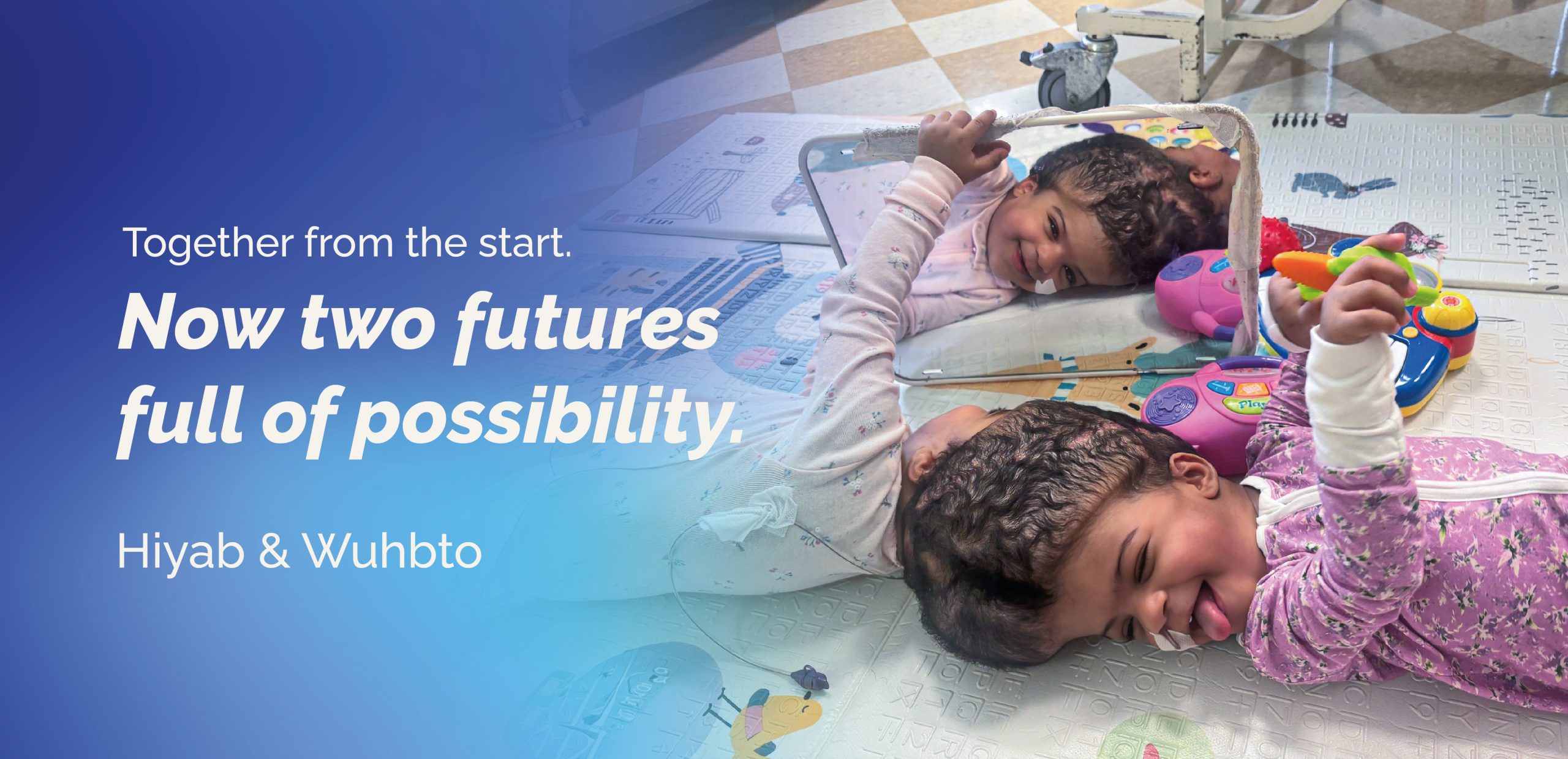
World Pediatrics assembled and coordinated a dedicated network of volunteer caregivers who spent time with the girls throughout treatment. They read books, sang songs, played peek-a-boo, blew bubbles and supported the developmental experiences every young child needs. That steady presence helped create stability around the girls while their medical teams prepared for separation.
World Pediatrics also continued advocating for the girls and their family, supporting their guardian and connecting the many organizations involved in their care. Ronald McDonald House Charities provided lodging and hospitality for their guardian during the extended stay in St. Louis.
Partnership Turned Access Into Action
No single organization could have carried Hiyab and Wuhbto through this journey. Each partner took responsibility for a different part of a continuous pathway built around the girls.
At SSM Health Cardinal Glennon Children’s Hospital, multidisciplinary pediatric teams developed the clinical strategy, delivered specialized medical care, multiple pre separation surgeries, and performed the complex separation surgery on February 24, 2026. The procedure, including preparation, lasted more than 24 hours.
Ranken Jordan Pediatric Bridge Hospital cared for the girls before separation surgery and is providing the rehabilitation and recovery support they need afterward. Its teams are helping each girl work toward individual medical and developmental milestones while giving them opportunities to play, learn and experience childhood beyond the bedside.
Lola Children’s Home remained part of the girls’ care network in Ethiopia. Ethiopian Airlines made international travel possible. Ronald McDonald House Charities gave their guardian a home base in St. Louis. World Pediatrics connected and sustained the operational and human infrastructure around the entire journey.
Partnership was not a supporting detail in this story. It was the model that made progress possible.
A Medical Success and a Continuing Commitment
Hiyab and Wuhbto’s successful separation was an extraordinary medical achievement. Today, they are recovering as two separate girls. Their medical, rehabilitation and developmental needs will continue to evolve, and the months and years ahead will help their care teams better understand what each child needs. World Pediatrics remains committed to the girls, their guardian and the partnership surrounding them. Our work does not end when a child reaches the hospital or when a procedure is completed. It continues for as long as responsible coordination, advocacy and support are needed, in many cases until a child reaches 21 years of age.
For more than 25 years, World Pediatrics has helped children cross the geographic, operational and systemic barriers separating them from advanced pediatric care. Hiyab and Wuhbto’s story is exceptional, but the challenge at its heart is one we see every day: treatment may exist, yet access does not. Our role is to help close that distance, one child, one pathway and one partnership at a time.
Deliver, Empower and Transform
Hiyab and Wuhbto’s experience reflects how World Pediatrics creates lasting access to advanced pediatric healthcare. We deliver care by connecting children with specialized treatment they cannot access close to home. We empower care by bringing together the people, partners and resources needed to support each child. And we transform care by building stronger pathways and partnerships that help more children reach the right care sooner. For Hiyab and Wuhbto, these three commitments came together around an extraordinary care journey that continues today.
How You Can Help
Supporters make it possible for World Pediatrics to respond when a child’s path to care is complex, urgent or far from home. Your gift helps us coordinate specialized treatment, remove barriers, support families, train local healthcare professionals, advance systemic change and build the partnerships children need to reach care.
Follow Hiyab and Wuhbto’s continuing journey at https://bit.ly/two-futures. To help create pathways to care for more children, visit worldpediatrics.org/donate.